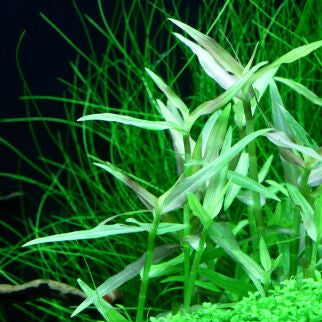
Murdannia keisak 6 stems 15cm
Murdannia keisak 6 stems 15cm
Couldn't load pickup availability
Murdannia keisak
Murdannia keisak, commonly known as marsh dewflower or Asian spiderwort, is an annual herbaceous plant in the spiderwort family (Commelinaceae). Native to East Asia, it naturally grows in wetlands, marshes, rice fields, and along the edges of ponds and streams.
It has slender, succulent stems that often creep along the ground and root at the nodes, allowing the plant to spread quickly. The leaves are narrow, lance-shaped, and bright green. During late summer and autumn, it produces small three-petaled flowers that range from white to pink, lilac, or pale purple.
In natural conditions, Murdannia keisak often forms dense mats of vegetation and is appreciated for its delicate flowers and graceful, wild appearance.
Cultivation
Murdannia keisak prefers moist to wet soils and grows best in sunny or lightly shaded positions.
Growing conditions
Light: full sun to partial shade
Soil: moist, fertile, humus-rich soil
Water: constant moisture is ideal; it also tolerates shallow water
Temperature: prefers warm conditions and active growth from spring through autumn
Because the stems root easily where they touch the soil, it establishes quickly and can be used in wet borders, bog gardens, pond margins, and paludariums.
Propagation
Propagation is very easy.
By cuttings: stem fragments with nodes root rapidly in moist soil or shallow water
By seed: the plant produces many tiny seeds that germinate readily in warm, damp conditions
Its fast rooting habit makes it easy to multiply but also means it should be monitored in small spaces.
Curiosities
In Asia, Murdannia keisak is often associated with traditional rice-growing landscapes.
Each flower usually lasts only a single day, but the plant keeps producing new blooms over an extended period.
The stems can regenerate from fragments, which is one reason it spreads so efficiently.
In some regions outside its native range, it is considered invasive because it can form thick mats that outcompete local vegetation.